English
 Deutsch







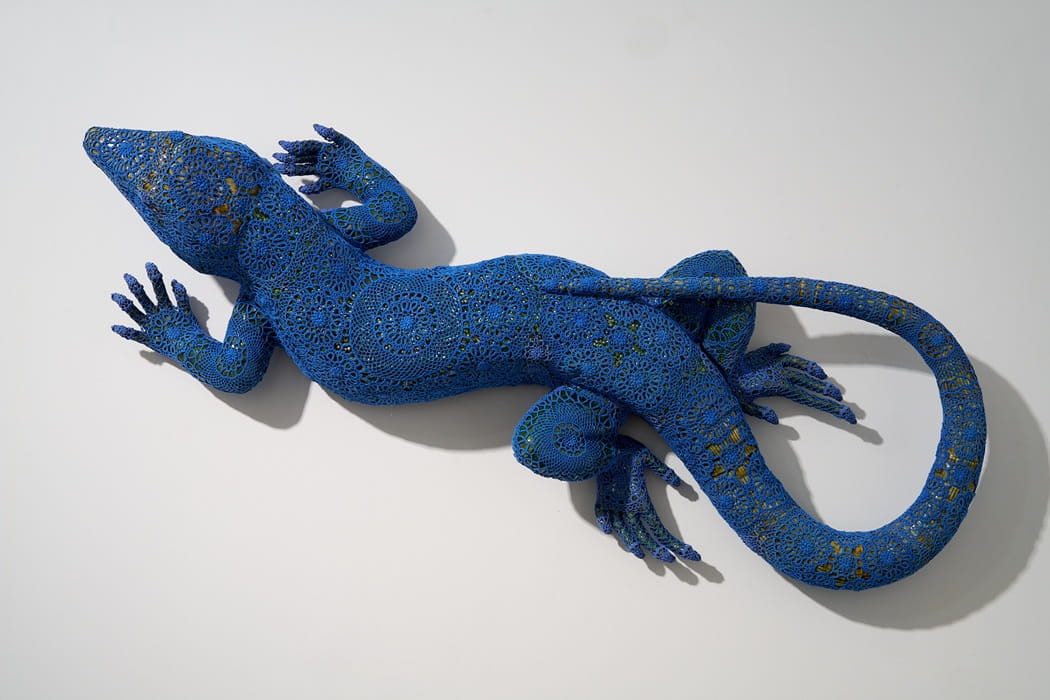
until 24.10. | #5161ARTatBerlin | Galerie Deschler shows from Thursday, 10. September 2026 the exhibition HANDMADE BY—Part II by the artists Georg Haberler, Seet van Hout, Bouthayna Al Muftah, Sergio Roger, Magda Sayeg, Yukiko Terada, Joana Vasconcelos and Gerhard Kehl.
At the beginning there is the thread. From a single, flexible fiber, a structure emerges through twisting, knotting, interlacing and binding—a structure that creates order without ever entirely resolving what is unruly. Thread connects and holds things together, traces lines and trajectories, while at the same time opening up the possibility of becoming entangled. Our language is rich in metaphors drawn from this realm: thoughts are spun further, connections are woven, stories unravel, we lose the thread or become emmeshed in contradictions.
Nine years after the first exhibition titled Handmade by, Galerie Deschler once again turns its attention to the multifaceted relationship between art and textile processes. Handmade by—Part II, curated by crochet work artist Patricia Waller, brings together international artists Georg Haberler, Seet van Hout, Bouthayna Al Muftah, Sergio Roger, Magda Sayeg, Yukiko Terada and Joana Vasconcelos, whose works explore, in very different ways, the boundaries between textile art, sculpture, installation and painting, while extending the engagement with the creative potential of the handmade through new artistic approaches. Alongside the textile works, the exhibition presents wooden sculptures by the artist Gerhard Kehl, who passed away two years ago. They introduce another dimension of craftsmanship and enter into dialogue with the textile works.

Gerhard Kehl, Snobbish Seahorse, 2001, 100 cm
What connects these works is not only a particular material—the thread—but also an attitude towards the process of making. Wherever textile techniques are employed, time itself becomes an integral part of the work. Repetition and patience encounter construction and chance; individual elements come together to form a whole. In this sense, the fundamental human experience embodied in textile work—the transformation of the tangled, disordered chaos of fibers, fluff and knots into a coherent fabric—points to an essential human capacity: that of creating connections and meaning from a multitude of disparate elements.
Here, the textile is not understood as a self-contained genre, but as a principle. It can expand, condense, conceal or reveal; define bodies and spaces; preserve memories and carry cultural experiences forward. The works on view demonstrate how seemingly simple materials and processes can give rise to complex visual and conceptual worlds—situated between craftsmanship and concept, intimacy and monumentality, order and dissolution.
Georg Haberler
Georg Haberler (b. 1985 in Graz, lives and works in Vienna) works with a sewing machine and acrylic paint—a hands-on process that combines painting and sewing to create a distinctive visual language. Thread and paint give rise to small, childlike figures and animals that tumble, balance, play and become absorbed in their games, often poised close to the edge of an abyss—an antidote to the sleekness and perfection of an increasingly technologized image world. The resulting compositions are less about telling stories than suggesting them, inviting viewers to continue the process of imagining with a childlike sense of curiosity.
Seet van Hout
Everything I want to tell, I share through my visual works. My work is a representation of me in the moment: how I look at things, what is happening around me, and my interpretation of this. Through this process, I try to give form to the wonders of Being Here. With the indescribable, the mysterious and the creation that echoes through Nature, the Universe, Memory, Beauty and Humankind. With an open mind, the intellect open to the surrounding world, like a radar searching for connection.
Gerhard Kehl
Starting in 2001, Gerhard Kehl (1964–2024), who also worked under the name -KEHL-, created wooden sculptures under the title Volkskunst. Combining traditional Erzgebirge woodcarving with the glossy, fantastical imagery of contemporary popular culture, Kehl transformed familiar forms of German folk art into something at once playful, enigmatic and distinctly contemporary.
Reduced to essential forms and often characterized by highly polished, lacquered surfaces, his sculptures oscillate between craftsmanship and conceptual art, tradition and modernity, familiarity and estrangement. Beneath their seemingly humorous or whimsical appearance lies a subtle reflection on cultural identity: Kehl uses the visual language of folk art to question how identities are constructed, inherited and transformed within contemporary society.
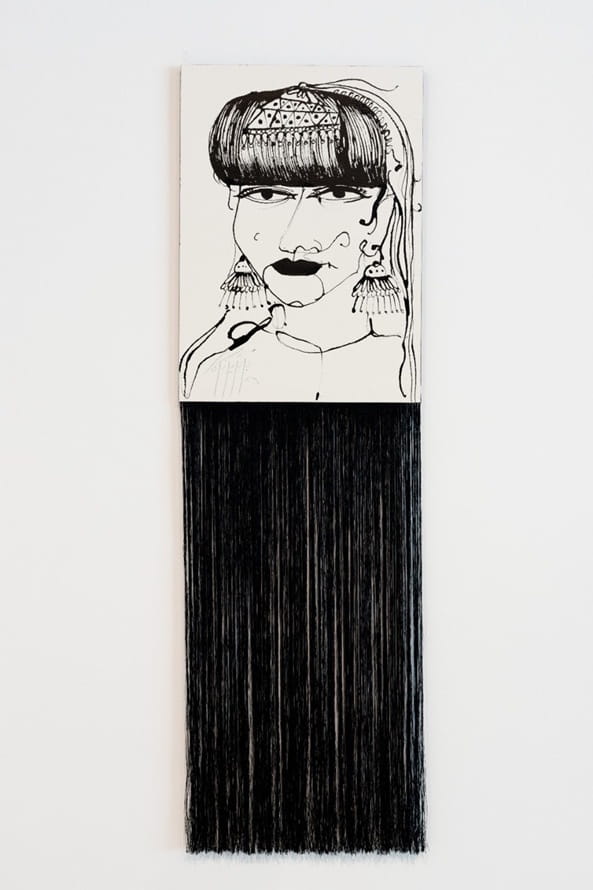
Bouthanya Al Muftah, Untitled – Series (GAADAH TITMASHATT تتمشط )فاعده | Brushing, 2026, 36 x 26 cm
Bouthayna Al Muftah
Brushing Her Hair brings together ideas from my previous bodies of work, Living: Architectures of Memory and Um Al Salasil WIl Thahab, which roughly translates to The Lady in Gold, exploring women, memory, identity, heritage, and how cultural narratives are carried through adornment, gesture, and inherited practices. Taking its title from a local/regional song describing a woman brushing or doing her hair, the work considers grooming and braiding as acts of care through which stories, experiences, memories, and cultural practices are passed between generations. These memories form a living archive, continually reshaped through repetition and experience, creating what I refer to as “the family of the neighborhood”, a network of women connected through care, belonging, and shared histories. Thread, ink, and paper evoke hair, connection, lineage, continuity, and the fragmented and layered nature of memory, reflecting how memories are accumulated, repeated, and reassembled over time. Extending into performance-inspired video and still imagery, the work explores memory as an inhabited and evolving structure, revealing how identity and heritage are continually shaped by what we inherit, remember, and choose to carry forward.
Sergio Roger
Sergio Roger is a Barcelona-based contemporary artist whose textile sculptures and installations reinterpret ancient art from a contemporary perspective. His practice challenges conventional historical narratives and Western museography, questioning ideas of permanence, memory, and historical certainty. Combining technical mastery with conceptual inquiry, his work explores collective identity, the sacred, and the intersection of universal myths with personal narratives.
Magda Sayeg
Magda Sayeg is a pioneer of yarn bombing whose practice has explored the intersection of textile, sculpture, architecture and public space for more than two decades. At the core of her work is the transformation of familiar objects and structures through handmade textile, bringing intimacy and traces of the human hand into monumental or functional environments. Significant site-specific interventions include the textile transformation of Louise Bourgeois’ “Maman” at the Mori Art Museum in Tokyo, more than twenty ten-meter-high palm trees for “Dubai Walls”, an entire stairwell transformed with red knitted material at La Condition Publique, and an intervention on a 200-year-old open-air theatre in Shanghai’s Yu Garden. By shifting scale and context, she challenges conventional ideas about where textile belongs and how we perceive architecture and public space. Her work preserves the identity of a site or object while opening it to new emotional, spatial and material perspectives.
Yukiko Terada
Yukiko Terada has continued a research journey tracing the unexpected connections and historical ties, woven through fabric and embroidery, between distant places that, at first glance, seem to have no relation to one another. Her Endless Embroidery series, based on a journey spanning Berlin, northeastern Japan, and Iceland, uses German “Rolltuch” and embroidery hoops to build up semi-three-dimensional forms on the wall. Within each embroidery hoop, motifs that share common meanings or similar forms across two different cultures are deconstructed and reassembled, exploring points of contact between them. The needles are also left in place at the ends of the embroidery threads. This reflects a hope that embroidery, a practice passed down for generations by unnamed women across various regions of the world, will continue into the future.
This exhibition also presents the record of this journey and the process behind the making of the works, together with the accompanying publication that compiles her practice to date: The World is Innocence—Places where Fabric and Embroidery Weave History.
Joana Vasconcelos
Almost a universal language, crochet has different expressions across the globe, yet requires no translation. I have bought crochet pieces all over the world and remain amazed by their richness and variety. For centuries, crochet was one of the few creative outlets available to women, crafted in domestic settings for protection and decoration. Later relegated to the back of drawers, it became stripped of meaning and significance. Imbued with the intimacy of the private sphere, it evokes memories driven by emotion rather than rationality. I use crochet in my Valkyries, draped over cement and clay figures, and in Bestiary, featuring ceramics by Raphael Bordallo Pinheiro.
Raphael is one of Portugal’s greatest artists. I grew up with his animal ceramics in my family homes, so bringing them into contemporary art felt natural. I cover horses, bulls, wolves, cats, snakes, crabs and other animals with crochet pieces sourced from Pico Island in the Azores, where women artisans continue this exquisite tradition. The resulting works explore our connection with the animal kingdom and the tension between comfort and power. The animals we choose to feed on or domesticate reveal our private and collective imagination. In this way, I honor the legacy and skill of the women who have always practiced crochet.
Curated by Patricia Waller & Galerie Deschler Berlin
Vernissage: Thursday, 10. September 2026, 7 – 10 pm
Exhibition period: Thursday, 10. September until Saturday, 24. October 2026
To the Gallery
Title image caption: Joana Vasconcelos, Danubio, 2023, 25 x 55 x 125 cm
Exhibition HANDMADE BY—Part II – Galerie Deschler | Zeitgenössische Kunst in Berlin | Contemporary Art | Exhibitios Berlin Galleries | ART at Berlin