English
 Deutsch







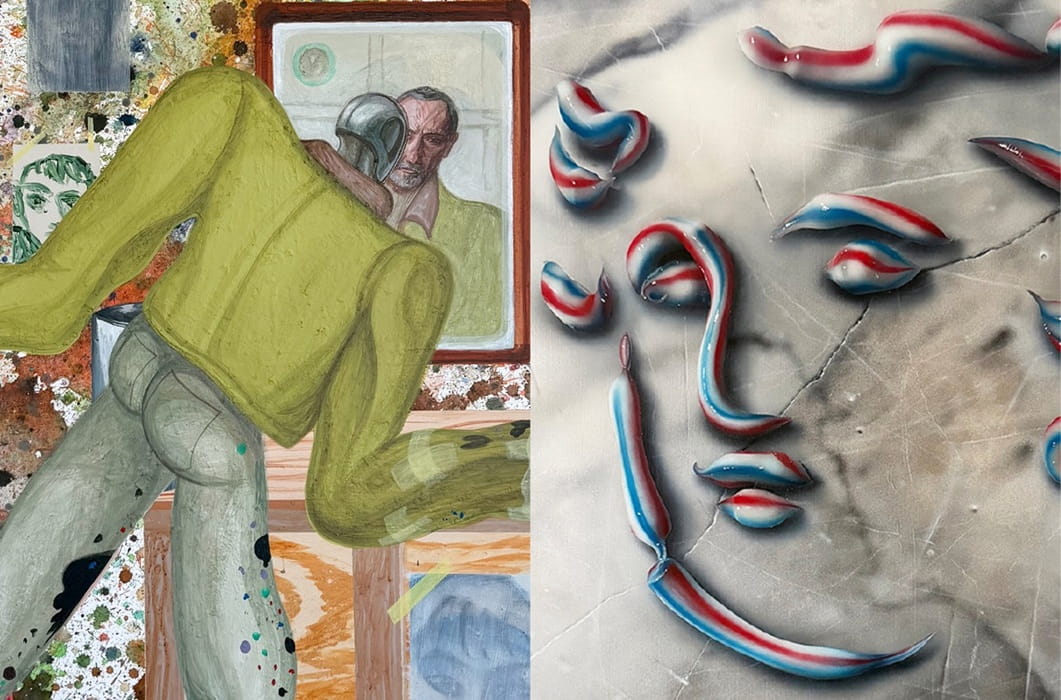
until 19.09. | #5110ARTatBerlin | Galerie Kristin Hjellegjerde in Berlin shows from Thursday, 13. August 2026 (Vernissage: 12.08.) the exhibition Tired Horses by the artists Robert McNally and Charlie Roberts.
Ancient artifacts, wilting flowers, and faces sketched with thick strokes of toothpaste. An artist who is downright obsessed with painting self-portraits. “Tired Horses,” a two-artist exhibition by Robert McNally and Charlie Roberts at the Kristin Hjellegjerde Gallery in Berlin, delves deep into the artists’ psyches and explores what it takes to lead a creative life.
The exhibition title refers to Bob Dylan’s “All the Tired Horses” and the German short film of the same name by Sebastian Mayr. With the repeated line “All the tired horses in the sun / How am I supposed to get any riding done?”, the song reflects a sense of creative frustration and exhaustion that Dylan felt at the time. The film, on the other hand, is a reflection on intimacy—on what we reveal and what we hold back. Taken together, these references frame the exhibition as a reflection not only on artistic exhaustion but also on the persistent act of creation in spite of that exhaustion—an idea that lies at the heart of the dialogue between McNally and Roberts.
McNally is interested in the tension between knowledge and ignorance, intimacy and distance, constraint and chaos. His works typically emerge during periods of isolation, which allow him to retreat deeply into his own thoughts and his archive of collected images. For this exhibition, he returns to a period of artistic exploration when he lived in Berlin and created time-consuming pencil drawings, as well as experimenting with toothpaste as a medium—a material he could not preserve except through photographs. These images are reinterpreted here in acrylic paint—transience is made permanent—with the toothpaste taking on a glossier appearance, tracing the outlines of a face from antiquity or a caricature. In another series of paintings, the toothpaste takes on a sculptural quality all its own, forming the stem of a drooping flower that reflects day and night—not only in a temporal sense, but also as psychological states. McNally draws heavily on what he calls the “subconscious impulse,” and the contradictory shadow in the night painting reflects this sense that something else is being revealed.
In addition to the toothpaste works, there are also compositions—such as the painting “Strangeways”—that are more typical of McNally’s oeuvre: multi-layered, featuring diverse perspectives, materialities, art-historical references, and “Easter eggs” that connect the individual works. The sense of touch and the act of creation remain central and are expressed through sculptural objects, a ballpoint pen, and a torn image of an artist at work. In the artist’s hands—which, in turn, are depicted in a subtly different manner (one arm appears to protrude from the edge of the picture, severed from the shoulder)—are a paintbrush and a scalpel, a palette smeared with paint, and a blob of toothpaste. The figure’s focused gaze is further intensified by the linear cut around his face, from which blood is dripping. Here, the artist appears both immersed in the act of creation and alienated from it, caught between control and decay.
While the figure of the artist in McNally’s painting suggests a shift within the self, Roberts extends this experience outward into the surrounding space. In his depiction of an artist’s studio, the artist has evolved into a cyborg-like figure, with oversized, elongated limbs and a metallic helmet for a head. Images of his former self are visible everywhere, most clearly in his reflection, which gazes at the viewer with an expression of skepticism over the robotic head. This jaded self, however, is not the one we see in the self-portraits hanging on the walls splattered with paint—these images appear more youthful, as if the artist were trapped in a cycle that repeatedly pulls him back into the past.
The chaos of this scene contrasts with the tranquil interiors Roberts usually paints, even though the architecture still conveys a sense of frustration or confinement. In the painting “Time Probe,” for example, in which a large figure stands with his back pressed close to a corner of the room, the only way out of the room seems to be through a tiny door that appears at the base of a side table—a door that would only allow a mouse to pass through. The room itself is aesthetically pleasing, with white panels reminiscent of a lattice-like, minimalist Japanese style: a vase of flowers, seedlings growing in tin cans, a sleeping dog on a rug. Yet the absence of real windows or views to the outside is unsettling—the interpretation of this space is ambiguous. The figure itself seems trapped in a similar dilemma; its numerous limbs and two heads reinforce the sense of the uncanny while also suggesting repetitive movements. As with all of Roberts’ compositions, the narrative is deliberately left open: Is the figure simply daydreaming, or is she stuck in a kind of psychological loop? Is the space a place of confinement or of order—and at what point does one merge into the other?
In the works of both artists, repetition, duplication, and spatial disorientation emerge as common features of their creative processes, suggesting not so much stagnation as perseverance. The act of returning—whether to an image, a space, or a material—becomes a gesture of hope and renewal.
ROBERT MCNALLY
Robert McNally (born in 1982 in Newcastle upon Tyne, UK) lives and works in Leicestershire, UK. He graduated from Camberwell College of Art at the University of the Arts London in 2005. McNally’s creative process is extremely labor-intensive and marked by solitude. His dedication to the meticulous and physical act of drawing is central to his practice and his artistic expression. Drawing on influences from his childhood—video games and science fiction—his work straddles the boundary between the digital and the analog. He explores an inner landscape of loneliness, belonging, and isolation through his engagement with technology and the malleability of context and history in the post-internet world.
CHARLIE ROBERTS
Roberts’ works draw on sources from art history and pop culture. While he works exclusively to hip-hop music in his studio, Lil Wayne and Rick Ross inspire him just as much as his other role models, the European Renaissance masters Pieter Bruegel and Van Eyck. The result is brimming with energy, determination, and a unique expressiveness. The clean lines that trace the figures’ contours create a seductive and distorted realism—the beautiful female figures are all painted with a very bold attitude that stems from the parallel universe of hip-hop culture and its ability to create the illusion of a glamorous lifestyle. Charlie Roberts was born in 1984 in Kansas, USA, and lives and works in Oslo, Norway. He studied at the Emily Carr Institute of Art and Design in Canada and at the University of Kansas in the USA.
Vernissage: Wednesday, 12. August 2026, 6 – 8 pm
Ausstellungsdaten: Thursday, 13. August – Saturday, 19. September 2026
Title image caption: Details aus Charlie Roberts, Ancient Evening, 2026 | Acryl und Graphit auf Leinwand | 120 x 130 cm & Robert McNally, Lover, 2026 | Acryl auf Holz | 50 x 40 cm
Exhibition Robert McNally & Charlie Roberts – Kristin Hjellegjerde Berlin | Zeitgenössische Kunst in Berlin | Contemporary Art | Exhibitions Berlin Galleries | ART at Berlin