English
 Deutsch





until 06.06. | #4998ARTatBerlin | Gallery Judin shows from Friday, 1. May 2026 the exhibition Non-Fiction by the artist Jorinde Voigt.
For Gallery Weekend Berlin 2026, Galerie Judin ist pleased to present Jorinde Voigt’s first solo exhibition with the gallery in their Mercatorhöfe space.
Standing before Jorinde Voigt’s recent works, what first comes into view is not a style, but an attitude that does not retreat. It does not seek to decorate reality, to replace it, or to wrap it in concepts so that it becomes easier to bear. It pauses. Through action, through painting, it opens a fissure in time in the air and steps into the present before it has been explained, before it has been smoothed over. That is the place the body must endure. Reality does not always arrive in the form of events; it also arrives as pressure, as vigilance entering the body again and again.
The title of Jorinde’s solo exhibition at Galerie Judin in Berlin, Non-Fiction, is already perfectly clear: there are no illusions lent to reality here, no fictional allegories. If one suspends facile lyricism, how does painting remain possible? What can the hand still bring into being? What the hand can do is something more difficult: to acknowledge that we are here. To acknowledge that the world is happening, and that the human being must bear it.
This is why If-Then-Condition I–IX matters so deeply. Completed in 2025, these nine works on paper do not console; they awaken. They do not soothe; they gather consciousness back into itself. Here the body and perception shoulder reality together. The pinks and pale reds in this group do not arise from any decorative preference; they are closer to the colors of alarm, colors that compel perception to wake. And yet they also preserve a softness, a warmth of empathy. These works do not set out to explain the external world. Rather, they seem like a “dialogue partner” the artist has summoned for herself—an interlocutor that enables one to retain the capacity for dialogue even under the pressure of reality. She calls consciousness back to itself. She is asking: in an age like this, can perception remain whole?
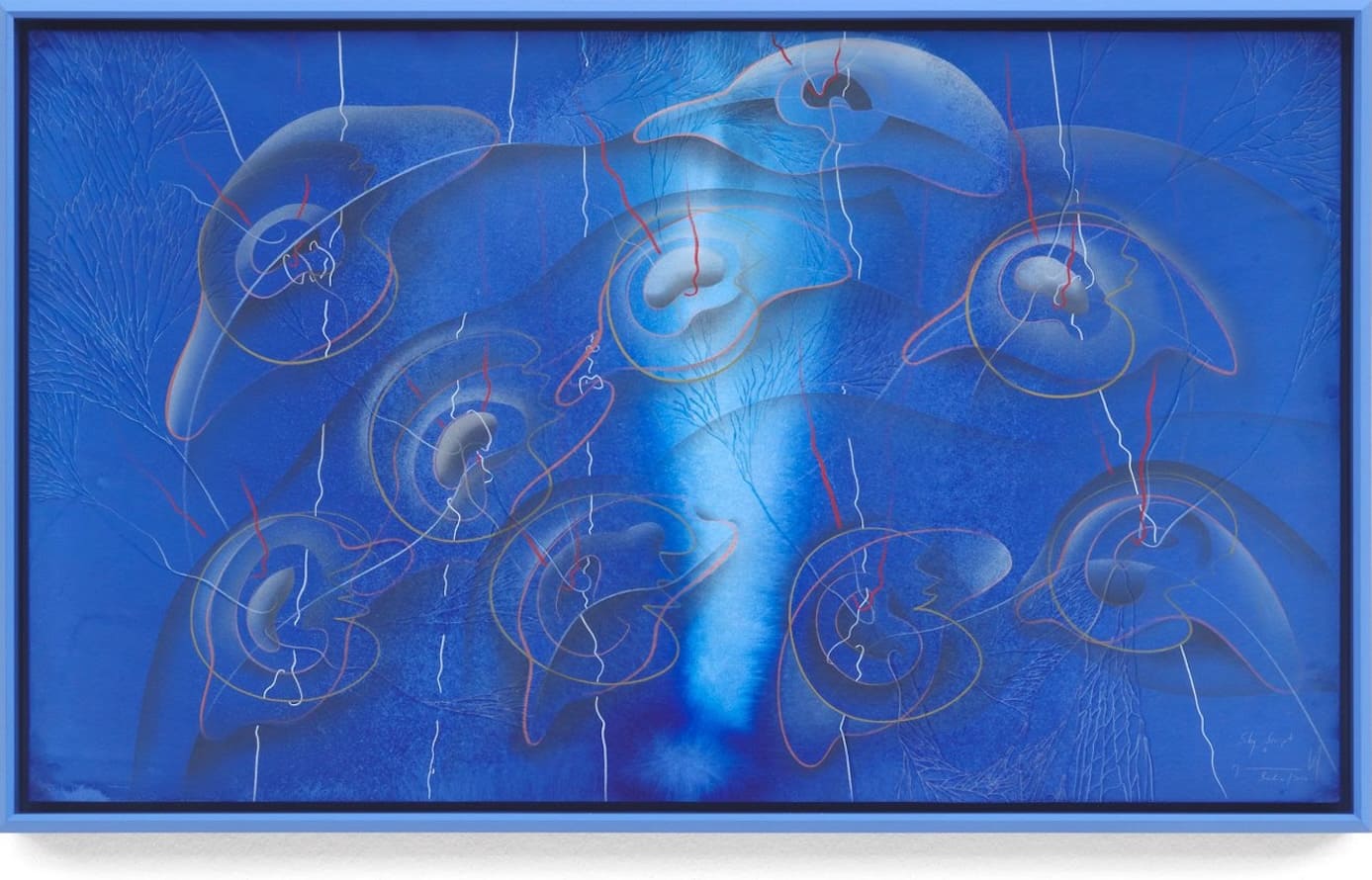
A few months later, Sky Script I–VI extends this “dialogue” into a more expansive field: sky, weather, time, paper, the body, and a process of formation that can never be fully controlled. Jorinde has said that the blue in these works does not come from the concept of “sky,” but from an intensely specific moment: the first blue sky of the year. She stood in her studio, looked out the window, and tried to approach that instant of blue through hand-mixed color. Reality does not arrive under the grand name of itself; it first arrives as the color temperature of a moment, as the angle of light, as a manifestation that cannot be repeated.
This suite of six works, completed in 2026, is composed on paper in graphite, gold leaf, ink, and pastel powder. Ink seeps into the paper; before it has fully dried, the sheet is tilted, and pigment slowly sinks under the pull of gravity. Water is splashed across the surface, and white traces emerge. Wind, temperature, the speed of drying—all become irreplaceable parts of the work. The work is no longer simply “made”; it becomes an event, an emergence of rule and unknown. In that moment, the author does not stand above all things issuing commands. Jorinde stands among them—alongside time, weather, paper, water, and contingency. She says: this is my sky, my reality. Not because I have named it, but because I was there within it, bearing that moment together with it. So certain, so solid, so unassailable—far more so than the reversals of the news cycle or the shifting truths and falsehoods of the internet.
She no longer understands herself as the sole controller of the image but is more willing to acknowledge the shared participation of weather, time, and material conditions in the work. For her, this is a rigorous position of reality: every parameter leaves a trace, every condition alters the outcome. The lines in these works are no longer merely visual ciphers, as they were in her earlier practice, for melody, wind direction, or trajectories of movement. They become, more fundamentally, testimony of the body itself—pulse, breath, gesture. What Jorinde calls the “trace of action” is not a description of emotion, nor a verification of the self, but an honest record left behind when body and world meet.
Jorinde says that what truly continues to concern her is “notation.” Her inquiry begins from a philosophical question: how can observation be compressed into a small number of parameters? How can action follow a set of invented rules? How can the information contained within movement be made visible? In this sense, Voigt remains a researcher and an inventor. She seeks to devise a visible structure for experiences that cannot be fixed, cannot be fully articulated in language. This is not in order to define the world, but to allow the world’s complexity to appear in its most abstract form.
What is most compelling in these new works is the creative state they themselves reveal. Jorinde says that in recent years she has consciously tried to free her practice from the pressures of external rhythms and continuous performance, allowing works to remain in the studio for longer, allowing one series to enter deeper resonance with the next. She has begun to permit the not-yet-defined to exist. And that, precisely, is a reality information: a gap not yet appropriated by discourse, one worth prying open through painting, so that it might become a negotiation with the world.
If Non-Fiction possesses a political dimension in today’s sense, it does not come from slogans, nor from the speed of taking a position. On the contrary, its sharpness lies in its refusal to be reduced to a position. Jorinde is acutely aware that today’s art world is increasingly constrained by fear, censorship, and self-discipline, increasingly prone to slipping into functionality and instrumentality under external pressure. The risk she is willing to take is to expose once more the vulnerability of process itself, to return to public view those parts that are still forming, still without a name. Such a stance is itself a response to reality: amid pervasive uncertainty, to defend the complexity of perception, to defend a truth not wholly replaceable by external language, a truth that still comes from within the body and from the interior of experience.
What this exhibition ultimately touches is not merely an update in Jorinde Voigt’s method of making art, but her answer to the question of why art is still necessary at all. She is not only answering, “How do I paint?” She is also answering, “Why do I paint?”
In these newest works, she returns the present to reality and perception. These works are quiet, but they are not tamed. She refuses the manifesto, yet on a deeper level they constitute a stance: in an age of turbulence, art need not be a fiction for escaping reality but can instead be a path for re-entering it.
Text: Shen Qilan
Jorinde Voigt, born in Frankfurt/Main in 1977, studied fine arts with a focus on photography and multimedia at the Royal College of Art in London and at the Berlin University of the Arts under Prof. Katharina Sieverding, where she graduated as a Meisterschülerin in 2004. Parallel studies in sociology, philosophy, comparative literature, and modern German literature at the Free University of Berlin and the University of Göttingen rounded out her education. From 2014 to 2019, Voigt was a professor at the Academy of Fine Arts in Munich, and since 2019 she has been teaching as a professor of conceptual painting and drawing at the University of Fine Arts in Hamburg. The artist lives and works in Berlin and Hamburg.
Opening: Friday, 1. May 2026 von 6 until 9 pm
Exhibition dates: Friday, 1. May 2026 – Saturday, 6. June 2026
To the Gallery
Bildunterschrift Titel: Jorinde Voigt, Sky Script 2, 2026, Graphite, ink and pastel on paper, 76 × 125 × 8 cm (framed)
Exhibition Non-Fiction – Galerie Judin | Zeitgenössische Kunst in Berlin | Contemporary Art | Exhibitions Berlin Galerien | ART at Berlin