English
 Deutsch







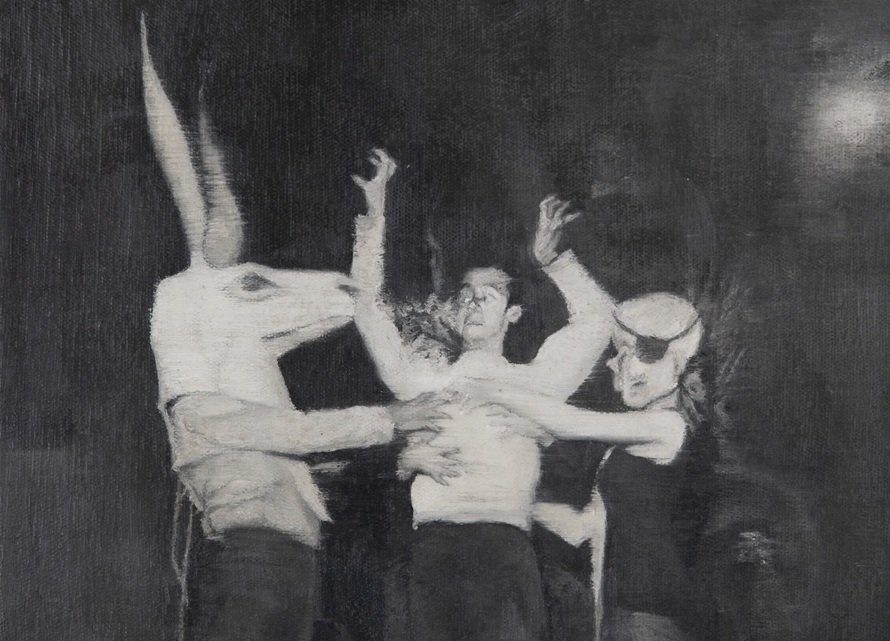
until 16.08. | #4656ARTatBerlin | neugerriemschneider (linienstrasse) shows from 03. May 2025 (Opening: 02.03.) the group exhibition „advective motion, nebulous currents“ by the artists Ai Weiwei, Isa Genzken, Louise Lawler, Sharon Lockhart, Tomás Saraceno, Simon Starling, Tobias Rehberger, Shilpa Gupta, Mario García Torres, Thomas Bayrle, Pae White, Andreas Eriksson.
The group exhibition advective motion, nebulous currents takes obfuscation as its focus, with narratives dissolved behind fog, distorted, streaked, rippled and pixelated in transformative actions, or softened to blurs. Here, in sculptures, photographs, prints and textiles, the rigidity of an articulated image dissipates and reality becomes malleable — undefinable and fleeting. As compositions meld in on themselves, perception reconfigures to scenes dreamlike and surreal, with afterimages, reverberations and ambient fluidity reflecting the ambiguities of modern existence.
Ai Weiwei – Nord Stream, 2022
Ai Weiwei’s Nord Stream (2022) uses a photograph of the whirlpool resulting from a ruptured Nord Stream 2 natural-gas pipeline, taken by the Danish Ministry of Defense, as the base for its large-scale iteration in pixel-like Lego bricks, creating a link between the source and its wide-spread presence across digital media. Captured southeast of the Danish island of Bornholm on September 27, 2022, a day after the leak began, the aerial view encapsulates over two decades of heated international relations, and brings to mind the artist’s own career-long political involvement and activism. In using a seemingly playful, readily accessible medium, Ai leverages the colorful bricks’ approachability to draw attention to a critical moment, while employing their playful associations to give rise to tension between the material’s expected levity and the crucial, yet fragmented, scene on view.
Thomas Bayrle – And Back Again – Helke II, 1991
Emerging in the 1960s from the visual languages of contemporary graphic design, advertising and mechanized weaving, Thomas Bayrle’s practice leveraged the mass-produced object and networks of infrastructure as tools for portraiture. Instrumental to this process was what he dubbed the Superform: a method of assembling series of repeated motifs to a larger image. In And Back Again – Helke II (1991), Bayrle presents a portrait of his wife, the Superform’s component parts here separated and flattened. No longer readily readable as a human likeness, the work takes on an abstraction rare for the artist, its optically rich patterning sending the gaze into a frenzy of misdirection.
Andreas Eriksson – Lidköping No. 10, 2024
Employing a diverse archive of linens and silks, Andreas Eriksson’s Lidköping No. 10 (2024) builds upon the artist’s signature fields of color, translated to a hand-woven tapestry, augmented by organic, fringe-like inclusions. Threads emerge from the composition’s ground, draping over and sporadically masking its textured surface to cascade downward. They appear as if unraveled from their sources, yet upon closer inspection, are revealed to be intentional inclusions methodically ordered along an unseen grid, evolved from and expanding the principles of his painted works.
Mario García Torres – When Stillness Produces Beautiful Moments, n.d.
Mario García Torres’ sculptural work When Stillness Produces Beautiful Moments (n.d.) is a poignant tribute to Alighiero Boetti — the Italian conceptualist to whom the artist has dedicated a number of crucial projects throughout his career. Here, García Torres takes as his point of departure Boetti’s Autoritratto (Mi Fuma Il Cervello) (1993–1994) — a self-portrait in which a bronze garden hose arcs water onto its head, where the stream meets heating elements and quickly turns to steam. García Torres’ work reduces Boetti’s self-portrait to just its hose, forming a monument to absence left in the wake of his outsized impact, and a testament to transformation and the vaporous nature of thought.
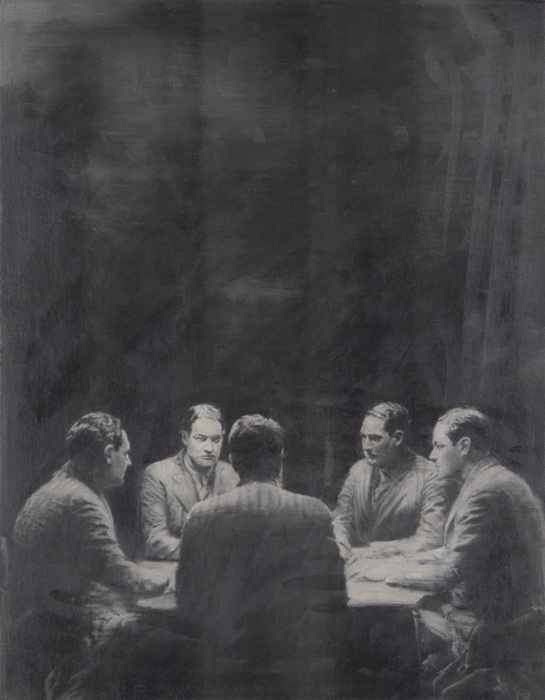
Isa Genzken – Wolfgang, 1998
Isa Genzken’s Wolfgang (1998) is part of a series of sculptural works by the artist in which she assembles metallic and wooden panels to columns that tower above a viewer in approximations of contemporary architecture and its sleek glass exteriors. In Wolfgang, sterile mesh plates and warm-toned boards of fine-grained wood alternate as they ascend the monolith, revealing and concealing the structure’s barren interior in measured intervals. The layers of perforated material give rise to a moiré pattern that complicates the work’s strict structure, countering the principles of Modernism with contrasting, individualized modes of perception.
Shilpa Gupta – Untitled, 2016
Plumes of dense smoke waft through the 12 panels of Shilpa Gupta’s photographic work Untitled (2016), where curled apparitions take on shapes indefinite and infinite, dodging focus as they emerge from the edges of each composition. As much of Gupta’s work, Untitled too addresses the paradox of definitions, in particular the arbitrary nature of borders and the methods with which they are often drawn and enforced. Evocative of clouds, the pictured smoke is granted free passage into the domestic, its very presence the deconstruction of traditional divides.
Louise Lawler – What Is Painting (swiped), 2022/2023
Louise Lawler’s What Is Painting (swiped) (2022/2023) — part of a series of photographs distorted by her moving camera and its open shutter — sees the bright canvas and dark lettering of John Baldessari’s What Is Painting? (1966–1968) blur as if in dynamic motion. Spatially shifted, or “swiped,” Lawler’s action enters into conversation with Baldessari’s. She counters the painting’s semi-ironic message through layers of appropriation and reinterpretation, and in turn, interrogates the conditions of authorship, institutional display and canonization.
Sharon Lockhart – Untitled, 2023
A mid-winter landscape as it rises gently before the camera, obscuring the approach to the sea that sits behind it, features in Sharon Lockhart’s Untitled (2023). Tall grasses, rendered pale by the season’s set-in chill, are coated in airy layers of falling snow. Fog looms, creating a nearly empty sky — the image’s intricately textured lower segment starkly contrasts the void that lies above it, masking the world that presumably lies beyond. Here, Lockhart re-engages with the seascapes and shorelines that have pervaded her practice for the past decades in a musing on a relentless, life-sustaining, yet unknowable force.
Tobias Rehberger – Utagawa Kunisada Shiko no nagame 1829 I, 2015
The vibrantly colored mural in Tobias Rehberger’s Utagawa Kunisada Shiko no nagame 1829 I (2015) sees a pixelated image, coded and imperceptible until viewed from a distance or reduced to fit a screen. Only then do the oversized, square-shaped modules merge to a facsimile of an erotic Japanese shunga woodcut. This print sits behind a vase that, clad in this same motif, seemingly disappears against its background, camouflaging itself while remaining in plain sight, thus allowing Rehberger to interrogate how context informs an object’s impact and allows it to transform.
Tomás Saraceno – Wayra 246, 2025
Tomás Saraceno’s Wayra 246 (2025), a sculptural network of solid-glass polyhedrons composed to cloud-like clusters of interconnected modules, appears to exist at the intersection of air, water and earth. The work’s suspended structures intertwine and seem to physically support one another through their shared facets, prompting questions on notions of space, order and symbiosis. Here, Saraceno juxtaposes the static nature of sculptural forms and the organic movement of natural systems, while the faces’ enigmatic transparency hints at the fluidity of boundaries and the interdependence of systems and their surroundings.
Simon Starling – Pin Board Painting, 2021
In the meticulously constructed, two-part installation Pin Board Painting (2021), Simon Starling takes as a point of departure an early 20th-century installation view from what was then the Berliner Nationalgalerie in Berlin (today the Alte Nationalgalerie), recreating this once-miniscule catalog reproduction in magnified form using black push-pins. The countless pins are precisely clustered such that their round heads emulate an offset print’s method of rendering an image. Re-photographed and shrunk back to the image’s initial dimensions as discovered in its source, the inserted push-pins begin to visually coalesce, forming what appears as the original installation photograph, and in turn crafting a commentary on the subjectivity of the image.
Pae White – Noisy Calm, November, 2025
With her tapestry Noisy Calm, November (2025), Pae White returns to the elaborate process of translating the ephemeral to woven materials, paying tribute to the natural world’s splendor. To reinterpret the tradition-rich, labor-intensive, enduring technique of weaving, she fabricates a digital image using an industrial Jacquard loom in a clash of media and theme. Here, threads of cotton and polyester capture the elusive by way of a lakefront landscape. Softened behind low-lying mist, the articulated image begins to dissolve, suspended between representation and abstraction, inscrutable and barely tangible.
Opening: Friday, 2. May, 6 – 9 pm
Exhibition date: Saturday, 3. May – Saturday, 16. August 2025
Gallery weekend Berlin: Saturday, 3. May 11 am – 7 pm to Sunday 4. May 11 am – 6 pm
To the Gallery
Image caption title: Shilpa Gupta, Untitled, 2016 digital photograph printed on Photo Rag paper 12 parts: 43 x 33 cm each © Shilpa Gupta. Courtesy the artist and neugerriemschneider, Berlin. Photo: Jens Ziehe, Berlin.
Exhibition advective motion, nebulous currents – Galerie neugerriemschneider | Zeitgenössische Kunst in Berlin | Contemporary Art | Ausstellungen Berlin Galerien | ART at Berlin