English
 Deutsch







until 07.02. | #4900ARTatBerlin | Kristin Hjellegjerde Gallery Berlin shows from Thursday, 08. January 2026 (Opening: 07.01.) the exhibition Orbital by the artists Alina Birkner, Johan Deckmann, Kyriaki Goni, Alexa Kumiko Hatanaka, Parsa Hosseinpour, Melanie King, Anna Kubelík & Tarik Goetzke, Maryam Lamei Harvani, Hannah Luxton, Roman Manikhin, Eeman Masood, Hormazd Narielwalla and Janet Vollebregt.
“Seen from here, Earth resembles the sky. It is bursting with colour. A hopeful riot of colour.” This sentence from Samantha Harvey’s novel Orbital sums up the strange duality at the heart of the exhibition: the excitement of viewing our world from afar and the quiet longing that this distance can evoke. The group exhibition Orbital at the Kristin Hjellegjerde Gallery in Berlin brings together paintings, sculptures, collages and prints by artists who see the cosmos not as a place of refuge, but as an opportunity to redefine our relationship with the Earth and with each other. In their works, images of the sky become a lens through which we can reflect on vulnerability, ecological change and our understanding of our place in the world.
Anna Kubelík presents a series of large-format prints made with “stardust” and printing blocks that capture the traces of beetles that have infested the bark of trees. Each print is an image of change, a trace of what has passed and what remains. They are accompanied by an audio work created in collaboration with Tarik Goetzke. In these audio recordings, we hear the perspectives of various characters – the spruce tree, a bark beetle, a forester – reflecting on the changes in their environment.
A series of luminous paintings by Alina Birkner reflects the invisible creative forces that surround the earth and determine our natural rhythm. Colours merge together to create flowing, expansive surfaces that suggest the vibration of energies and the blending of elements. Eeman Masood’s paintings also depict luminous forms in magical, changing worlds – radiant peacocks, salmon, water and stars that, for the artist, speak of renewal and resilience. Guided by the principle “The universe is within us” (Rumi), Masood’s works reflect a sense of quiet harmony and wonder.
Two works by Melanie King reinterpret NASA photographs of Mars and Saturn by developing them by hand using an analogue process with plant-based, non-toxic materials. This method creates a more intimate, sensual engagement with the material and what it represents, reflecting the shift in perception that astronauts experience when viewing the world from a distance.
Maryam Lamei Harvani‘s paintings reinterpret the ancient Gol-o-Morgh miniature tradition, in which the bird symbolises the lover in search of the divine and the flower symbolises the beloved, divine beauty or a guiding light. Each composition is created in a deeply meditative process in which thousands of dots and lines are combined to form a shimmering, coherent whole.
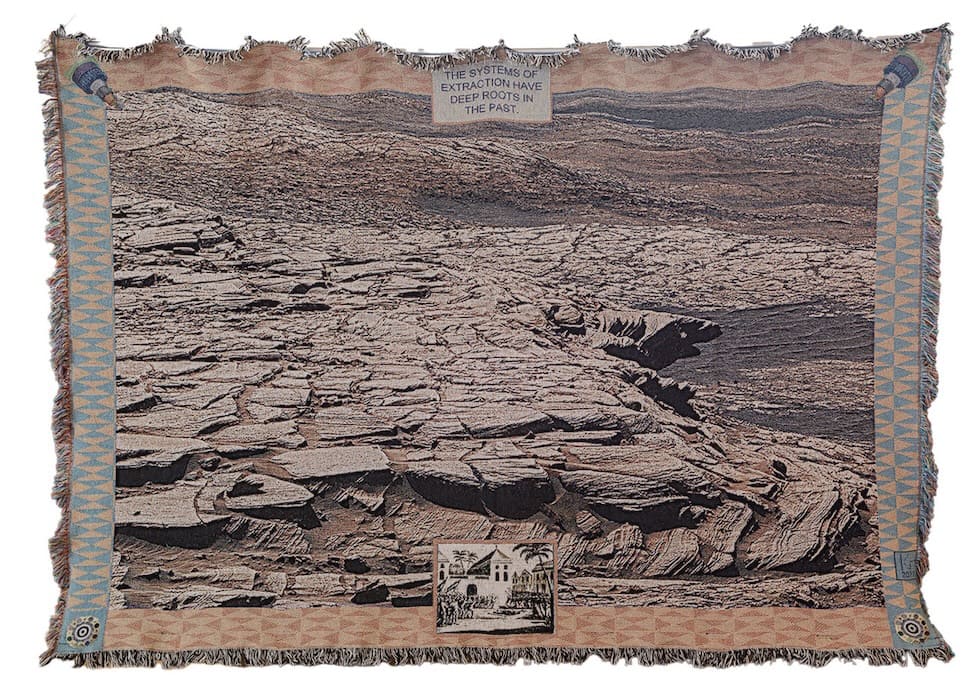
A series of machine-woven tapestries by Kyriaki Goni depicting landscapes of Mars examines the neo-colonial practice of space exploration and the exploitation of extraterrestrial environments. The soft feel of the tapestries has something provisional about it, conveying a gentler, feminist perspective—a perspective that raises the question of whether it is possible to approach new terrains with care and respect.
As an artist and practising psychotherapist, Johan Deckmann works with fabric-based books and found objects, reflecting on the complexity of life with humour and empathy. For this exhibition, he returns to painting and presents a series of new text-based works. In Hannah Luxton’s work, the sphere appears both as a heavenly symbol and as a universal form that defies language and transcends cultural boundaries. Her ellipses stretch time and space and allude to the orbits of the planets. Through various forms of representation, Luxton suggests the ellipse as both positive and negative space, a playful paradox for the imagination.
While working for a tailor on Savile Row, Hormazd Narielwalla began collecting patterns discarded after customers passed away, reinterpreting them as abstract artworks that became his series Moving Constellation. In these works, the “map” of the body becomes an imaginary constellation of stars, dotted with black dots reminiscent of unknown matter, dust or ashes. Roman Manikhin also literally imagines the body as something that moves through space. His playful wooden sculptures, created for the gallery’s winter garden, tell an Odyssey-like story in which the inhabitants of Earth are forced to leave their planet due to dangerous circumstances. They set out in search of a new home, travelling on rockets or asteroids and encountering bizarre – or even sexual – situations along the way.
A large-format work by Alexa Kumiko Hatanaka consists of 91 sheets of handmade kozo paper onto which she has applied a landscape print using the block printing technique. An interrupted line in the image, where the paper has been left unprinted, traces the increasing use of the word “vulnerability” as depicted in a graphic. Based on her experiences with bipolar disorder, the work explores how a breakdown in the climate can also affect our inner landscape. Parsa Hosseinpour’s paintings use layers of fabric to similarly reflect on a sense of collective loneliness and how this feeling can be most pronounced in crowded situations.
Janet Vollebregt‘s practice has its roots in architecture and Eastern and Western philosophies, with a particular focus on Jin Shin Jyutsu, an energetic healing art from Japan. She works with subtle energy to harmonise both the user of the space and the space itself. In this exhibition, she presents two “Building Piercings” and a “Double Pendant,” inspired by the protective and decorative history of talismans and jewellery, as well as an ethereal landscape from her Ming Tang series.
Taken together, these works suggest that distance, whether spatial or emotional, can alter our perspective and suggest new ways of relating to the world and finding a sense of belonging.
Opening: Wedesday, 07. January 2026, 6 – 8 pm.
Exhibition dates: Thursday, 08. January – Saturday, 07. February 2026
Title image caption: Kyriaki Goni | Martian Landscape II, 2022 | maschinell gewebter Jacquard-Wandteppich | 140 x 200 cm
Exhibition Orbital – Kristin Hjellegjerde Berlin | Zeitgenössische Kunst in Berlin | Contemporary Art | Ausstellungen Berlin Galerien | ART at Berlin