English
 Deutsch





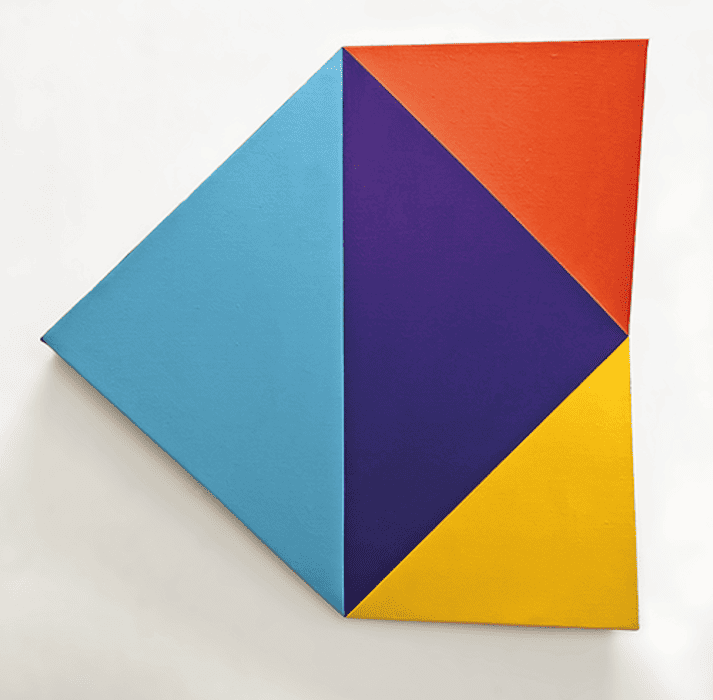
until 24.01. | #4873ARTatBerlin | Semjon Contemporary shows from Friday, 28. November 2025 (Opening: 27.11.) the exhibition New Horizons by the artist Dirk Rathke.
The exhibition title is bold and self-assured—as well as risky.
Dirk Rathke’s painting has long been recognized as a signature body of work because it is simultaneously color and form. In the early 2000s, the Berlin philosopher Dirk Koppelberg referred to this group of works as Curved Canvas. The term Shaped Canvas, which would also be appropriate, is already associated with the famous colleague Frank Stella. The artist himself calls them picture objects—painting that is expanded into space.
The early works, some of them also of considerable size, are highly reduced to a simple form (square, horizontal and vertical rectangle), whose corners sometimes project deeply into space and are thus unmistakably sculptural at the same time. A fine example can be found in the collection of the Nationalgalerie.
Over the years, the forms have become more complex, turning into polygons, and the picture edges can also appear wavy at times. Likewise, the artist has expanded the color palette. Pastel tones as well as gold and silver tones were added. The canvases, which he calls stretchings, could and can also consist of two canvases screwed together, one picture edge of which defines a diagonal line of the overall image and dynamically enhances the sense of movement depending on the height and depth of the picture corners. It becomes even more complex with the works that Rathke calls four-part pictures.
From 2016 onward, the group of works known as Foldings was added, which unfold monochromatically lacquered metal plates in a variety of diverse and idiosyncratic constellations and lift them into space. The wall objects Curves—round rods bent into space, sometimes also monochromatically finished—likewise form a distinct body of work.
The new exhibition presents works from the last two years that clearly define a paradigm shift.
Whereas the canvases were previously monochrome—even though the painter Dirk Rathke layered numerous coats of paint on top of one another to achieve the monochrome color effect, sometimes also incorporating textures through brushwork—the monochrome is now confidently broken open. The surfaces are divided into geometric color fields that form a whole. Various artistic strategies can be discerned here.
On the one hand, particularly in the framed 40 × 30 cm formats, the canvas is, for example, broken up into diagonally arranged right-angled areas that are rendered in different colors. The pictorial tension arises from the way the quadrilateral is subdivided into color fields and how these fields are placed, and from whether they interact harmoniously or disharmoniously with one another. The canvas surface can also be divided into acute-angled shapes (mostly triangles) or into irregular quadrilaterals or polygons, so that the composition alone already evokes dynamism and tension.
Then there are the canvases—quite classically Rathke—which, through the wedge-frame form that rises and falls into space, provide the basis for breaking up the otherwise monochrome surface into various colored fields that assert themselves with and against the three-dimensional form, emphasize it, or even counteract it.
A particular novelty is the creation of new canvas forms that reflect, in the frame silhouette, the offset joining together of irregular quadrilaterals that are at the same time monochrome color fields, thus allowing the quadrilateral, for example, to become a “twelvefold,” because it represents the outer edges of the four color fields.
A rather minimalist variant of a new series of works consists solely of a canvas primed with transparent rabbit-skin glue, which becomes the negative space for the geometric form created by the monochrome (or so it seems) application of paint, which is drawn over the front edge of the canvas to the rear side edge. The color of the canvas thus becomes the second color of the artwork. Astonishing is the resulting multilayered quality, which follows an actually simple rule: over a rectangular ground plan, the corners (and thus the picture edges) are pulled to different depths into space. The canvas stretched over this becomes the image carrier of a monochromatically painted geometric form that, offset diagonally or angularly, has its corner points at the rear edge of the stretcher frame. This formula evokes a complex appearance that changes radically from viewpoint to viewpoint and whose basic forms one must first grasp, so to speak tracing them with one’s eyes in order to understand them.
And when Dirk Rathke suddenly enters the realm of space by painting objects familiar to us—here one or more chairs, the classic Series 7 by Arne Jacobsen—whose seat and backrest, consisting of a curved form, through being painted with oil paint clearly mutate into a canvas, into art, and are no longer defined as utilitarian objects, he winks at a paradox: the chair that supports us in especially attentive contemplation of the artwork refuses this role and itself becomes art. An ensemble of three titled Who Is Afraid of Red, Yellow and Blue playfully alludes to Barnett Newman’s Who Is Afraid of Red, Yellow and Blue, counteracting its original intention and thus inviting discourse on the history of modern art.
Dirk Rathke fulfills the self-assured exhibition title New Horizons with a fireworks display of new works not previously seen in this way—and yet remains true to himself.
Text: Semjon H.N. Semjon, November 2025
Opening: Thursday, 27. November 2025, 7-9:30 pm
Exhibition dates: Friday, 28. November 2025 until Saturday, 24. January 2026
To the gallery
Titel image caption: Dirk Rathke, New horizons. Courtesy of Semjon Contemporary.
Exhibition Dirk Rathke – Semjon Contemporary | Zeitgenössische Kunst | Contemporary Art | Exhibitions Berlin Galleries – ART at Berlin