English
 Deutsch







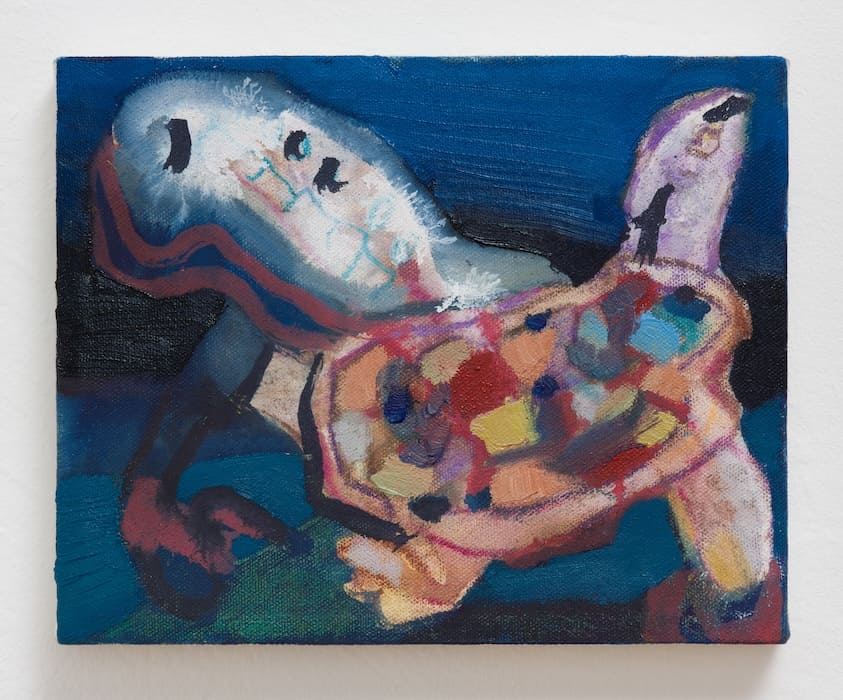
until 28.03. | #4941ARTatBerlin | Sexauer Gallery shows from Friday, 13. February 2026 (Opening: 12.02.) the exhibition „What if … forever“ by the artist Alexander Iskin.
In his eighth exhibition at SEXAUER, titled “What if” … forever, Alexander Iskin presents new works created during a stay in Mexico. As always, Iskin—the inventor of Interrealism—connects different worlds. He worked for several months in Mexico City (Santa María la Ribera) and in Mazunte, a small coastal town on the Pacific. Alongside his artistic practice, he volunteered at the turtle sanctuary Centro Mexicano de la Tortuga. There he witnessed egg-laying, the hatching of baby turtles, their journey to the sea, observed mating, and accompanied a turtle in death. Yet Iskin did not become an animal painter. Rather, his works invite us to dive into depth of the ocean and of the unconscious.
As an Interrealist, Iskin has always been interested in in-between worlds, seeking to make this “interreality” tangible. After initially exploring the space between digital-virtual and physical reality, and turning in 2024 to spirits and myths in Use the exit as an entrance, he expands the interreal space once more in “What if” … forever. Here, collective myths recede in favor of a connection to nature, a dive into the self, and an exploration of the unconscious.
Some paintings were begun in Mexico City, smaller formats were created in Mazunte, and all were completed upon his return. At Playa Escobilla, under the full moon, Iskin experienced the Arribada—the mass arrival of thousands of sea turtles to lay their eggs. After decades in water, the females come ashore for the first time; without buoyancy, their weight increases dramatically. With great effort they dig nests, lay around one hundred eggs, and return to the ocean. About fifty days later, hundreds of thousands of hatchlings emerge simultaneously and crawl—usually during the new moon—toward the sea. Only one in a thousand reaches sexual maturity.
During Arribada and Nacimiento (the hatching), the beach is protected by the military. As a volunteer at the sanctuary, Iskin was granted nighttime access. These experiences became existential. He allowed them to flow into his paintings, opening a space between nature and self—an interreality.
Painting is always also about painting itself. What is immediately perceptible is the image and the emotion; what can only be sensed indirectly are the experiences from which those emotions arise. Several of these experiences are linked to specific works to facilitate access to the exhibition.
Arribada was first based on Iskin’s imagination of such an event and later overpainted after his stay, adding weight and an additional layer of meaning. Golfina is dedicated to a young turtle that was dying, beside whom he sat daily. Deconstructed is based on an unusually white sea turtle, born blind, with an inward-curving shell.
Nacimiento is a key work. Iskin deliberately exposed a watercolor on canvas to rain, allowing irregular flows of pigment to penetrate the surface. While painting, he recognized a bird-like figure—foreshadowing the threat to newly hatched turtles. After witnessing the real Nacimiento, he completed the work.
Historias del Caparacón draws on the turtle shell as a biological archive. Field-like segments and a dense painterly gesture transform the surface into a carrier of memory.
El Ritual was created after Iskin’s return to Mexico City. Impressions of the coast overlap with a mass Independence Day event in September 2025 at the Zócalo, where President Claudia Sheinbaum delivered a speech. For Iskin, this simultaneity of experiences is interreal.
The Centro Mexicano de la Tortuga stands on the grounds of a former slaughterhouse where tens of thousands of turtles were killed annually until 1990. Today, the center focuses on breeding, rehabilitation, and release, though it remains underfunded. Ten percent of all sales from the exhibition will be donated to the sanctuary. Without Iskin’s stay there, this exhibition would not have been possible.
Sea turtles are among the marine animals most affected by human impact: plastic in their digestive systems, microplastics in their organs, toxins in their shells, deaths in fishing nets, loss of nesting grounds, ship collisions. And yet they are the result of over 120 million years of evolution. The hatching, the growth, the cycles of life and death—What if … forever.
Opening: Thursday, 12. February 2026, 6 – 9 pm
Exhibition dates: Friday, 13. February until Saturday, 28. March 2026
To the gallery
Titel image caption: Alexander Iskin, It’s always the moon, 2025, oil on canvas, 20 x 25 cm, Photo: Marcus Schneider, Courtesy: SEXAUER Gallery
Exhibition Alexander Iskin – Sexauer Gallery | Zeitgenössische Kunst in Berlin | Contemporary Art | Exhibitions Berlin Galleries | ART at Berlin