English
 Deutsch







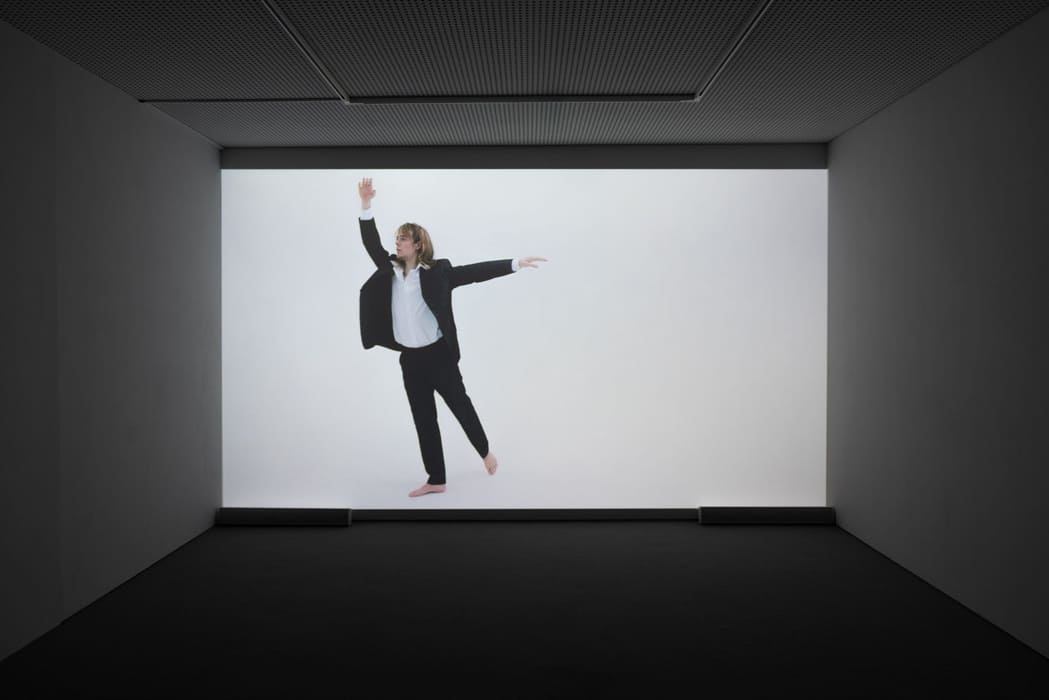
until 05.03 | #4923ARTatBerlin | carlier | gebauer currently shows the exhibition Herz by the artist Asta Gröting.
Paradoxically, the atmosphere of emptiness forms the heart of this exhibition, which refers like a delayed echo to the absent, the intangible. To what remains when seemingly nothing remains. Gröting brings minimal forms together to tell a story: squares on the floor complete a double bed, a washing machine performs gentle, rocking movements, all that remains of an intimate moment between two women is an imprint, a cold stainless steel heart with a needle poses the question of under what conditions one defends one’s country. The air has gone out of the pig.
With these settings, Gröting creates a poetry of space within space, where the material, tangible works become protagonists just as much as the relationships between the objects themselves. In this exhibition, Gröting confronts us with the intimate and familiar, the everyday. However, she does so in a subtle and distorted way, so that the “secret” always threatens to tip over into the uncanny and alien. She exhibits a kind of inner life, yet leaves its precise definition and the question of what exactly constitutes it open. In Space Between Two Women Having Sex (2024), Gröting made a direct impression with silicone during the sexual act between two women. The plastic space between the persons is turned inside out and mirrored from bottom to top—Gröting thus performs a kind of sculptural autopsy, both literally and conceptually. The negative space between two people becomes an object, bringing to light the unspoken, the secretive, and the hidden. What remains of the moment is the other side, the “underside” of the self. In the laser light installation Atemkurve (Breathing Curve, 2025), Gröting turns outward a process that our bodies perform every moment of our lives, but mostly automatically: breathing in and out, taking in fresh oxygen and releasing carbon dioxide from the blood. Oxygen, as a shared and vital resource that is invisible to the naked eye, can be seen as a metaphor for the essence of this exhibition by Gröting: her works make visible what seems self-evident or hidden and invite us to rethink these self-evident truths.
Gröting addresses the domestic sphere, a place of retreat but also of reproductive labor, historically associated with femininity, in two works that are barely discernible due to their minimal, suggestive gestures: four slightly curved rectangles become a made-up but empty double bed. Made of Styrofoam, they seem to float feather-light above the exhibition floor. As a moisture-resistant and heat-insulating material, it is used to protect sensitive objects. Waschmaschine (2024), on the other hand, reduces the almost indispensable appliance to a white pedestal with the typical dimensions of household appliances, so-called white goods. The pedestal performs very slow, barely perceptible horizontal and vertical movements.
Instead of retreating into the private sphere, the artist also highlights its political dimensions. Through domestication, pigs are closely linked to the history of human civilization. In addition, due to their intelligence and physiological similarity to humans, pigs are often used as laboratory animals in medicine and research. Lying flat on its side, Dancing Queen (2024) becomes a projection surface for all these debates, but above all, it urges us to reflect on the human relationship with living beings and the environment. The cold, chrome-colored heart (2025) also picks up on the symbolic dimension of this vital organ.
Among other things, it stands for a center, the core, which must also be protected by the rib cage. Combined with the German national colors, this work reveals an ambivalence between a sense of belonging, a certain atmosphere in which one grew up, on the one hand, and the consequences of confronting painful history and political injustices on the other. Gröting puts her finger, or rather her needle, on the sore spot of current areas of tension.
Asta Gröting (born 1961 in Herford, Germany) lives and works in Berlin, Germany. International solo exhibitions have been held at the Städel Museum in Frankfurt, Germany; the Centre Pasquart in Biel/Bienne, Switzerland; KINDL – Centre for Contemporary Art in Berlin, Germany; the ZKM Center for Art and Media in Karlsruhe, Germany; at the n.b.k. Neuer Berliner Kunstverein in Berlin, Germany; at the Lentos Kunstmuseum Linz in Linz, Austria; at the Henry Moore Institute in Leeds, United Kingdom; and at the Marta Herford in Herford, Germany. Gröting has also been featured in numerous international group exhibitions, including at the Musée des Beaux-Arts de Paris in Paris, France; at the James Simon Gallery in Berlin, Germany; the Staatliche Museen zu Berlin in Berlin, Germany; the Kunsthalle Bielefeld in Bielefeld, Germany; the 22nd São Paulo Biennial in São Paulo, Brazil; the 8th Biennale of Sydney in Sydney, Australia; the 14th Biennale of Sydney in Sydney, Australia; and the 44th Venice Biennale in Venice, Italy. In February 2026, she will participate in group exhibitions at the Städtische Galerie Villingen-Schwenningen, Germany, and in August at the Konschthal Esch, Luxembourg. In September 2026, she will present her work at Carlone Contemporary in the Belvedere Vienna, Austria.
Exhibition dates: Saturday, 17. January until Thursday, 3. March 2026
To the gallery
Title image: Asta Gröting, Herz, exhibition view at carlier | gebauer, Berlin, 2026 Photo © Andrea Rossetti
Exhibition Asta Gröting – carlier | gebauer | Herz | Contemporary Art | Exhibitions Berlin Galleries | ART at Berlin