English
 Deutsch







until 28.03. | #4950ARTatBerlin | Laura Mars Gallery shows from 21. February 2026 (Opening: 20.02.) the exhibition Cold Soup by the artist Dennis Fuchs.
Cold Soup does not refer to gazpacho or a smoothie-like concoction. Metaphorically speaking, the soup in Dennis Fuchs’s new works is anything but cold. With his characteristically subtle humor and a wink at the viewer, he presents large-format drawings, ultra-fine airbrushed clouds and pencil lines, a magnificent ceramic vessel, small figurative sculptures in cool poses—and, surprisingly, his venture into painting.
Over the years, Dennis Fuchs has scaled up his ambitions, moving from his beloved small cups and bowls to a centerpiece that lends the exhibition its name: a grand soup tureen, lidless and hand-shaped rather than wheel-turned. With this, Fuchs steps into a lineage of ceramic artistry, the vessel’s surface alive with folds, sculpted forms, and etched marks that echo Bernard Palissy’slegendary rustiques figulines. Geckos crawl and dangle along the rim, kin to Palissy’s reptiles. Figures and body parts twist from inside to out and back again, conjuring a dreamlike, deeply personal universe where forms melt and reassemble. Fuchs playfully distorts traditional forms and motifs, but his color choices nod to history: the vessel’s striking green glaze evokes celadon, itself a tribute to the jade hues of Ming dynasty ceramics.
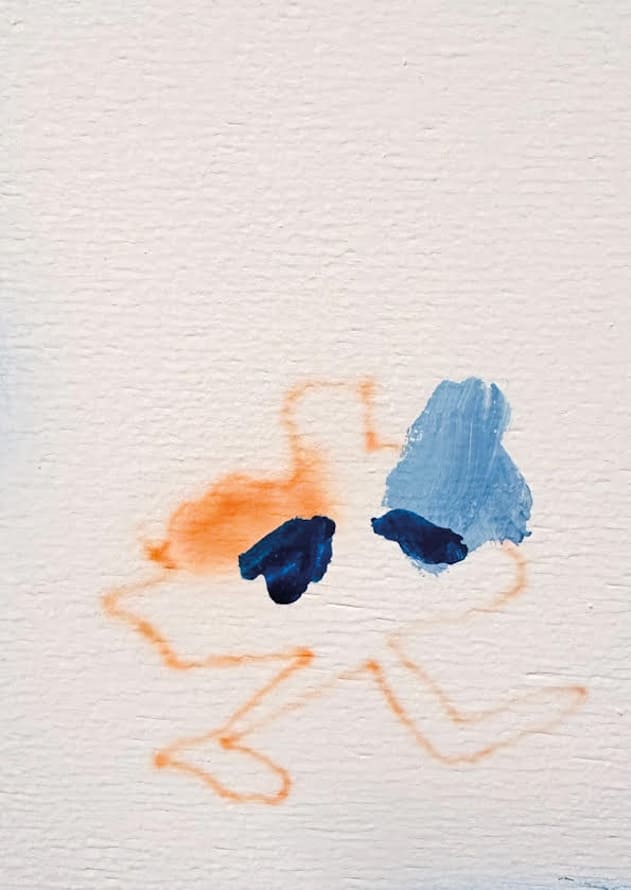
The User Bodies(2026) figures are made of porcelain, that mysterious, alchemical material Emmanuel Boos once called a ‘Don Quixote of matter’ for its unpredictable nature. These figures lounge in every imaginable relaxed pose, utterly absorbed in their smartphones, as if their devices have become extensions of themselves. Like Fuchs’s earlier anthropomorphic food figurines—playful nods to Fischli & Weiss’s sausage series—these bodies are perfectly proportioned, their scale and posture precisely tuned. Some appear kneaded and roughly shaped, others smoothed to a glossy finish, but all radiate convincing body language, their porcelain limbs attached just so. Gathered together, this group is lost in digital communion, creating a space where virtual closeness meets real-world distance. Or perhaps, they are tumbling ever deeper into the rabbit hole. By contrast, Fuchs’s airbrush drawings pare the figurative down to a whisper: just hands, legs, and fleeting body parts. The spray gun and ultra-fine nozzle, tools of Pop Art, photorealism, and commercial graphics, also belong to Fuchs’s world of graffiti, street art, and comics. This atomizing technique, introduced to fine art by Paul Klee, is visible, for instance, in Der Springer (1930). In Fuchs ́s work the color drifts into clouds and outlines dissolve into mist. Pencil and colored-pencil lines float over these airy fields, creating surprising depth on a small surface. Occasional brushstrokes hint at a painterly turn.
These elements are featured in the large diptych Scrolling the Expanded Field (2026), which references Rosalind Krauss’s 1979 concept, Sculpture in the Expanded Field, a groundbreaking text redefining the terrain of artistic production, using sculpture in space as its point of departure. Created on wood for its texture and sculptural presence, the work’s spray and drawing extend beyond the panel’s edges. The composition invites multidirectional viewing, similar to scrolling on a screen, and lacks a central focus, encouraging free navigation as in a crowded image composition in the tradition of Hieronymus Bosch. Figurative elements such as hands, legs, and body parts are depicted in motion. Fine, sometimes trembling lines are often just a “passing of the stroke,” as Roland Barthes described in relation to Cy Twombly: “a sublime form of the line that neither scratches nor wounds.” Speech bubbles and brackets remain empty, while symbols and miniatures imply thought. The rabbit-duck head directly references Ludwig Wittgenstein’s discussion of interpretive ambiguity between figuration and abstraction. Drawing on Max Imdahl’s concepts, Fuchs leads viewers from “recognizing seeing” to “seeing seeing,” emphasizing perception based on the image’s autonomy rather than the search for familiar forms.
In painterly pieces like Truth and Dare, Wiggle Room, and Minor Inconvenience (all 2026), Dennis Fuchs lets color steal the spotlight. These works feel like close-ups of his drawings, with lines that are barely visible and the softest spray fraying the edges of color fields. In the small Arensdorf Fill-Ins(2025), pure color mist fills the space, not pulsing like Mark Rothko but shimmering, hovering, almost dissolving. Whether lines fill or outline the field, the effect is mesmerizing—a feast for the senses, and certainly not cold soup.
Text: Dr. Klaus Ulrich Werner
Opening: Friday, 20. February 2026, at 7 pm
Exhibition dates: Saturday, 21. February – Saturday, 28. March 2026
To the gallery
Title image caption: Dennis Fuchs, Post-Whatever (detail), 2026, Acrylic, airbrush, colored pencil and pencil on wood, 96 x 96 cm
Exhibition Dennis Fuchs – Laura Mars Gallery | Zeitgenössische Kunst Berlin | Contemporary Art | Exhibitions Berlin Galleries | ART at Berlin